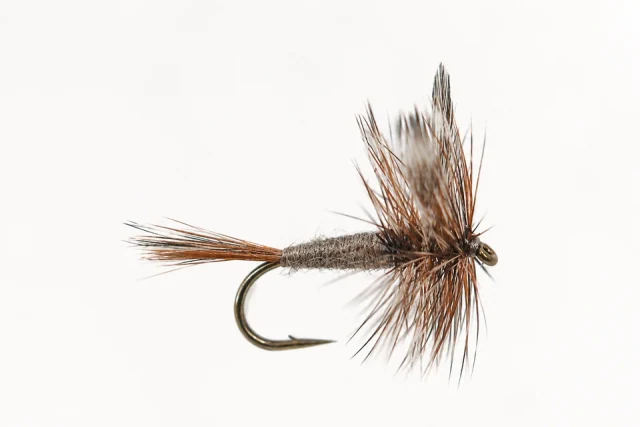
Satoshi Yamamoto’s documented Buddy Wing Emerger as a PMD representative, using a biot abdomen, foam-covered thorax and natural-dun CDC wings.
The index’s “Wing Nymph Emerger” label supplies no recipe. This is originator Satoshi Yamamoto’s named Buddy Wing Emerger in a PMD-matching color scheme, using his published material list. He describes it as a floating emerger; its exact appearance is not asserted to match the index photo. The tying order is an editorial reconstruction of his stated construction.
Work through the numbered steps in order, using the materials list and written proportions as your guide.
01
Lay a fine foundation
Mount the size 16 hook and wind pale Veevus 16/0 thread from behind the eye toward the bend, reserving the forward shank for thorax and wing.
Bench note Avoid a heavy thread build on this floating emerger.
02
Tie the mixed shuck
Secure several fine synthetic fibers at the bend and lay several mallard-flank fibers directly over them as Yamamoto specifies for the Emerger.
Bench note Keep both fiber groups sparse so they read as one trailing shuck.
03
Wrap biot abdomen
Tie the PMD-toned turkey biot at the bend and wind it forward into a slender, naturally segmented abdomen, stopping ahead of the thorax space.
Bench note Avoid crowding the eye; the wing structure needs room.
04
Mount foam and CDC
Tie a narrow black foam strip on top at the front of the abdomen and secure natural-dun CDC fibers upright where the buddy wing will rise.
Bench note Keep the CDC aligned and the foam narrow for a visible three-dimensional wing.
05
Dub and cover thorax
Dub a compact PMD-toned Superfine thorax under and around the CDC base, draw the black foam strip over the thorax and bind it down behind the wing.
Bench note Preserve the CDC tips and avoid compressing the whole wing into the foam.
06
Shape and finish
Arrange the natural-dun CDC into the prominent buddy-wing silhouette, trim excess foam, and whip finish a small head without coating the CDC.
Bench note Check that the foam and CDC can support the fly in the surface film.
Beyond the bench
On the water.
Present the Buddy Wing Emerger in the surface film during a mayfly emergence. Yamamoto developed the pattern after observing duns struggling to leave their nymph shucks; the CDC wings and foam support a surface presentation.