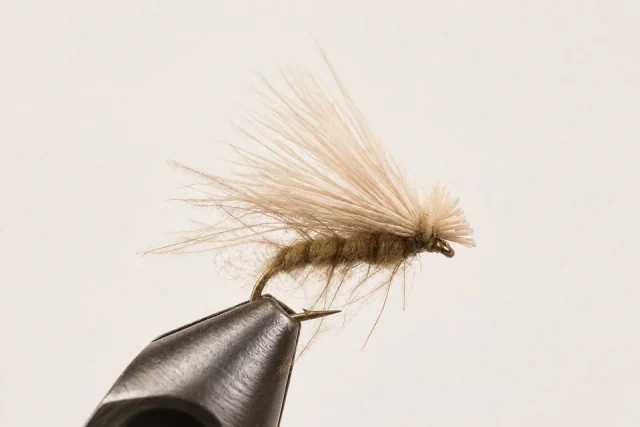
A buoyant Goddard Caddis exemplar with a shaped deer-hair body, brown hackle and paired quill antennae.
The source index shows an Olive Adult Caddis but does not reveal its tying recipe. This page uses the documented Goddard Caddis as one adult-caddis exemplar, without asserting that the source photo shows this pattern.
Work through the numbered steps in order, using the materials list and written proportions as your guide.
01
Mark the body space
Start rusty-brown thread at mid-shank and wind rearward. The front half remains open for hackle and antennae.
02
Flare the first hair clump
Clean a small clump of deer hair. Set its square-cut butts at the front of the hook and tighten thread gradually so the hair flares around the rear shank.
03
Pack and shape the body
Spin a second deer-hair clump at the middle, push it tightly against the first, then trim the packed hair into a caddis-like tapered body with a flat underside.
04
Set the antennae
Strip a brown hackle quill, fold it into a forward-facing loop and tie it on top of the open front shank. Leave enough exposed shank for hackle turns.
05
Wind the hackle
Tie in brown dry-fly hackle near the eye and wind close turns back to the deer-hair body. Secure the feather there and zigzag the thread forward through the hackle.
06
Finish the silhouette
Whip finish behind the eye, split and shorten the quill loop into two antennae, and make final scissor cuts to the deer-hair body.
Beyond the bench
On the water.
Skate or wake the buoyant deer-hair fly over active fish, or let it drift naturally on the surface.