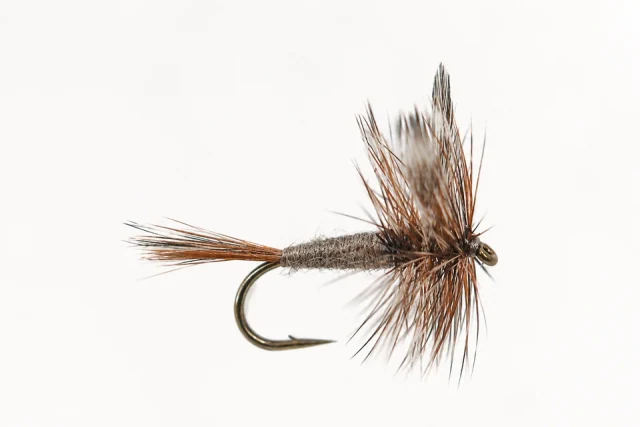
Kevin Compton’s tan-thread Callibaetis floating nymph, with a biot body and three CDC feathers drawn over a hare-fur thorax.
The Flys and Guides index labels a tan “CDC Floating Nymph / Emerger” without tying details. Kevin Compton independently supplied the complete material list for his Callibaetis CDC Floating Nymph in a 2011 tier interview. This is that named exemplar with an editorial tying sequence, not a claim about the indexed photo’s species or exact materials.
Work through the numbered steps in order, using the materials list and written proportions as your guide.
01
Start the tan foundation
Mount the dry-fly hook, start tan thread behind the eye and wind a smooth base to the bend, leaving enough front shank for a broad thorax.
Bench note Avoid a weighted underbody on this floating exemplar.
02
Set shuck and wire
Tie a sparse medium-dun Coq de Leon tail or shuck at the bend, then secure the extra-fine gold wire beside it for later segmentation.
Bench note Keep the tail slim rather than making a fan of stiff fibers.
03
Wrap the natural biot
Anchor the natural bustard biot at the rear and wind it forward into a slim abdomen that stops well before the hook eye; secure and trim it.
Bench note Even turns keep the biot body tidy without adding much weight.
04
Rib and mount CDC
Wind the gold wire in open turns over the abdomen, secure it, then tie the bases of three tannish-dun CDC feathers at the abdomen front with their tips trailing rearward.
Bench note Keep the CDC aligned on top so it can later be folded over the thorax.
05
Spin hare-fur thorax
Form a dubbing loop, place a sparse quantity of European hare fur in it and twist. Wrap the resulting brush forward into a soft, full thorax.
Bench note Pick out a few fur fibers for texture without burying the CDC tie-in.
06
Close the CDC wingcase
Draw the three CDC feathers over the thorax as a buoyant wingcase, tie them down behind the eye, trim excess and whip finish a neat tan head.
Bench note Do not coat the CDC fibers with head cement or resin.
Beyond the bench
On the water.
Use a careful dead drift in or near the surface film when Callibaetis nymphs are emerging in suitable stillwater. Treat the dry-fly hook and CDC wingcase as buoyancy elements; avoid soaking the CDC with heavy dressing.