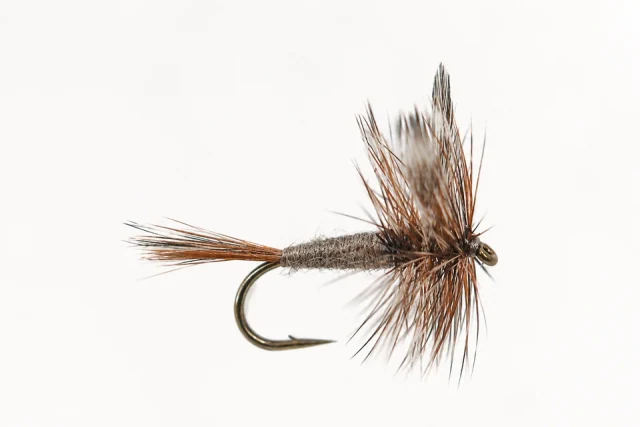
A copper-ribbed pheasant-tail nymph finished with a mobile partridge collar, shown here with a gold bead.
The swept partridge collar makes this a distinct soft-hackle dressing of the Pheasant Tail nymph. It can drift as a nymph and move as it rises or swings. The source index shows several soft-hackle Pheasant Tail entries; their colors and beads stay on this single page.
Work through the numbered steps in order, using the materials list and written proportions as your guide.
01
Seat the bead and rib
Slide the gold bead to the eye. Start olive thread one bead length behind it, cover the shank to the bend and tie small copper wire along the near side.
Bench note The near-side wire tie-in helps the first rib turn catch the body at the bend.
02
Tie tail and abdomen fibers
Align six pheasant-tail fibers and bind their tips as a short tail at the bend. Carry the remaining butt ends forward along the shank.
Bench note Keep the six fibers together for an even abdomen.
03
Wind and rib the body
Wrap the pheasant butts backward in adjacent turns to the tail base. Lock them there with the first copper-wire turn, then spiral wire forward in open turns and secure it.
Bench note The copper rib protects the fragile feather fibers.
04
Build a peacock thorax
Tie in one peacock herl strand and wind it densely in the space before the bead. Tie it off and add zig-zag thread turns to secure the soft stem.
Bench note Leave a narrow strip behind the bead for the partridge collar.
05
Set the partridge collar
Prepare one Hungarian partridge feather, tie it by its tip and take two or three sparse turns while stroking the fibers rearward.
Bench note Choose fibers around two hook gaps long for a mobile collar.
06
Whip finish
Secure the feather stem, trim it close and whip finish behind the bead. Clear any stray hackle fibers from the hook eye.
Bench note The collar should remain soft and swept back, not stiff like dry-fly hackle.
Beyond the bench
On the water.
Dead-drift below the surface and let the fly lift or swing at the end of a drift. Adjust depth for the run and avoid heavy line tension during the drift.