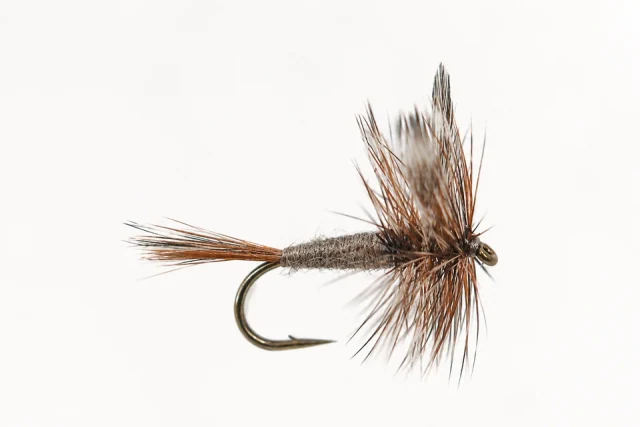
A red thread butt contrasts with peacock herl beneath a soft partridge collar.
This Ozarks soft hackle has a visible red rear section followed by a dark peacock body. The partridge collar moves freely when the fly drifts or rises in the water.
Work through the numbered steps in order, using the materials list and written proportions as your guide.
01
Form the red butt
Start the red thread several eye lengths behind the eye and carry it to the bend. Build a short, even red butt at the rear before returning the thread forward.
Bench note Keep the red section visible when the peacock body is added.
02
Anchor the peacock
Tie two or three peacock-herl strands at the rear, just in front of the red butt. Carry the working thread forward to reserve a short thorax and hackle space.
Bench note Secure the fragile herl with close thread turns.
03
Wind the body
Wrap the peacock herl forward in touching turns to create a full dark body. Tie it off before the reserved front space and trim the unused strands.
Bench note Avoid covering the red butt with the final herl turn.
04
Add thorax and hackle
Dub a small dark thorax. Prepare a partridge feather by removing its lower fibers, tie it by the tip and make about one and a half to two soft turns behind the eye.
Bench note Stroke the fibers rearward while winding so they do not trap one another.
05
Finish the soft hackle
Secure and trim the feather stem, sweep the partridge fibers back with a thread turn, and whip finish a small red head while keeping the hook eye open.
Bench note The collar should move rather than stand as a stiff dry-fly hackle.
Beyond the bench
On the water.
Dead-drift it below the surface, then let the fly lift and swing at the end of the drift. Rocky River Trout Unlimited and the MidCurrent tier both describe the Red Ass as a useful wet fly in this style.