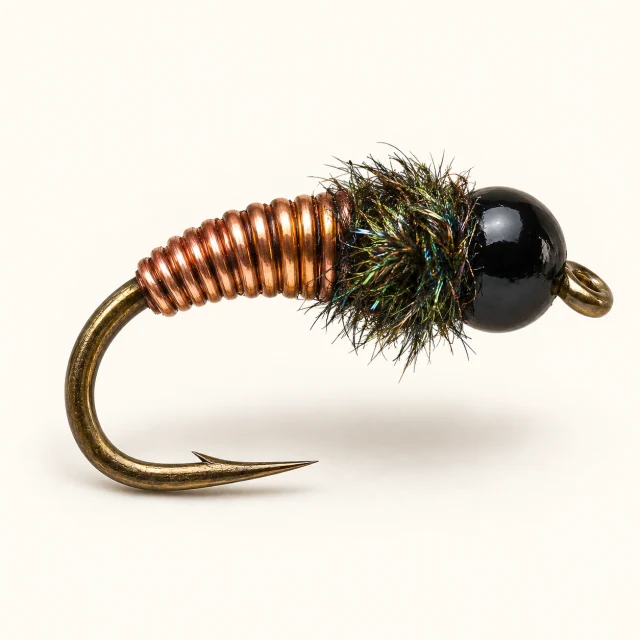
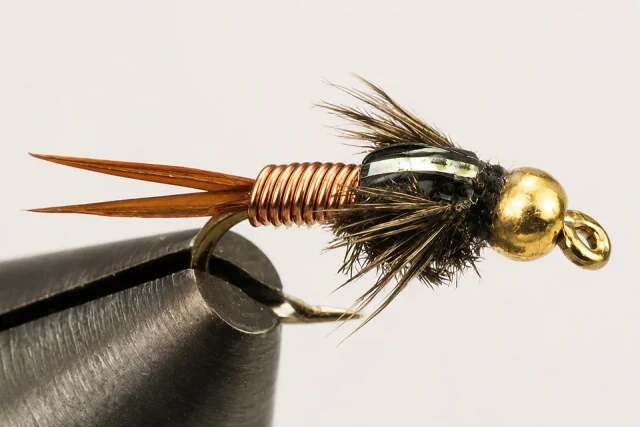
Guard-hair tail, two shades of squirrel dubbing and barred rubber legs under a bead.
The Red Fox Squirrel Nymph is credited to Dave Whitlock. This beadhead rubber-leg version follows the Missouri fly shop T. Hargrove’s published dressing, including different belly and back fur in the abdomen and thorax.
Work through the numbered steps in order, using the materials list and written proportions as your guide.
01
Seat bead and tail
Slide a brass bead to the eye and cover the shank with orange thread. Clean underfur from a small squirrel-back tuft and bind its guard hairs as a sparse tail at the bend.
Bench note Keep the tail near one hook gap in length.
02
Tie the rib and abdomen
Anchor a thin pearl Mylar strip at the tail base. Dub squirrel belly fur forward over roughly the rear two thirds of the shank, leaving a front space for legs and thorax.
Bench note Pick out a few fibers rather than making the body too thick.
03
Rib the body
Spiral the pearl Mylar forward in open turns across the dubbed abdomen. Secure and trim it where the front thorax space begins.
Bench note The rib should remain visible among the natural fur fibers.
04
Place the rubber legs
Tie one short orange-barred Sili Leg length to each side of the front shank, spreading the ends so they will project beside the thorax.
Bench note Keep the side lengths balanced and clear of the hook point.
05
Dub and finish the thorax
Wind darker squirrel back-fur dubbing between and around the leg tie-ins to make a compact thorax. Whip finish behind the bead and tease out a few guard hairs without tangling the legs.
Bench note Leave the bead and hook eye unobstructed.
Beyond the bench
On the water.
Use the weighted fly as a general subsurface nymph for trout. Its squirrel guard hairs and barred legs create a mobile outline; set depth for the run and keep the drift controlled.