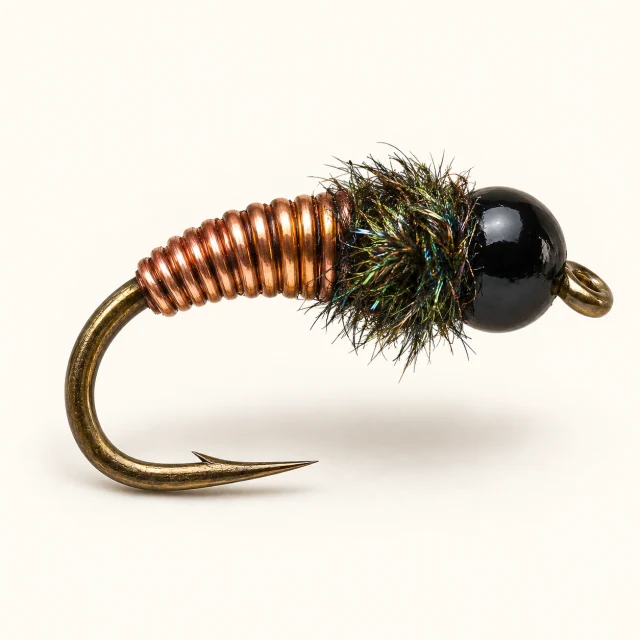
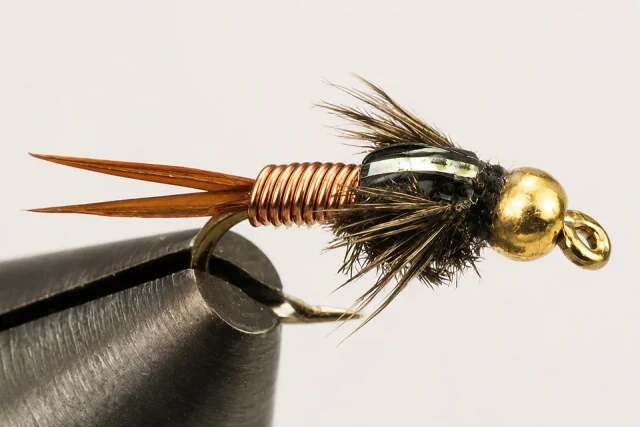
An olive squirrel-dubbing nymph with pearl rib, partridge hackle, salt-and-pepper thorax and tungsten bead; one independently documented buggy nymph.
Flys and Guides labels a beadhead Buggy Nymph but does not publish its dressing. This recipe follows Lucian Vasies’s independently published Troutline Tactical Olive Buggy Nymph material list. It is a named representative, not a verified reconstruction of the indexed photograph; the tying sequence is editorial.
Work through the numbered steps in order, using the materials list and written proportions as your guide.
01
Seat the bead
Slide a fitted tungsten bead to the hook eye, clamp the Demmon hook and start UNI 8/0 thread behind the bead.
Bench note Use a bead that seats against the eye without closing the hook gap.
02
Anchor the pearl rib
Wind thread to the rear of the shank and tie the pearl UV flat tinsel along the hook so it will rib the later olive body.
Bench note Keep the tinsel flat during tie-in so it does not twist into a cord.
03
Dub the olive abdomen
Twist olive pure-squirrel dubb sparsely onto the thread and wrap a tapered abdomen from the bend to roughly two thirds of the shank.
Bench note Leave a short front space for the contrast thorax and partridge.
04
Spiral the rib
Wind the pearl flat tinsel forward in open, evenly spaced turns over the olive dubbing, then secure and trim it before the thorax.
Bench note A few visible pearl turns are enough; the squirrel fibers should remain prominent.
05
Build thorax and hackle
Dub a compact salt-and-pepper thorax, then tie in a selected partridge feather and wind a sparse collar immediately behind the bead.
Bench note Stroke hackle fibers rearward between turns to retain the nymph profile.
06
Finish the head
Bind the partridge stem, trim it closely and whip finish behind the bead, then pick a few squirrel fibers free from the abdomen.
Bench note Clear the hook eye and preserve the soft, uneven outline.
Beyond the bench
On the water.
Drift this weighted, fuzzy nymph through current where trout feed near the bed. Its tungsten bead provides depth, while the squirrel and partridge fibers give a mobile outline.