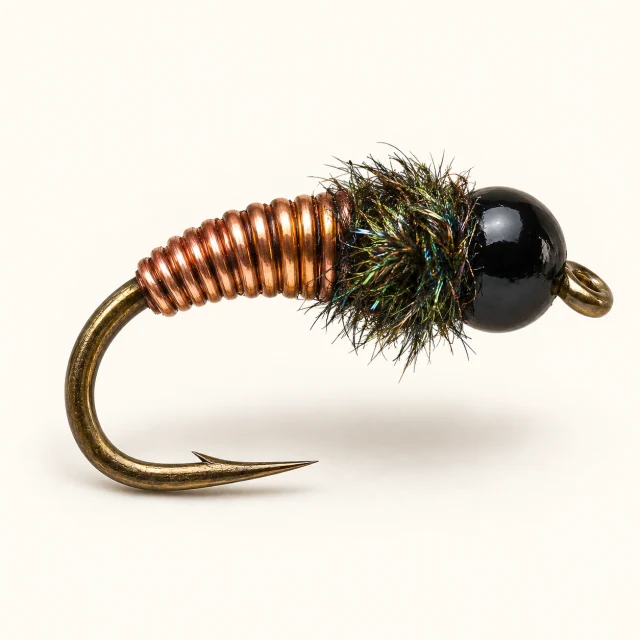
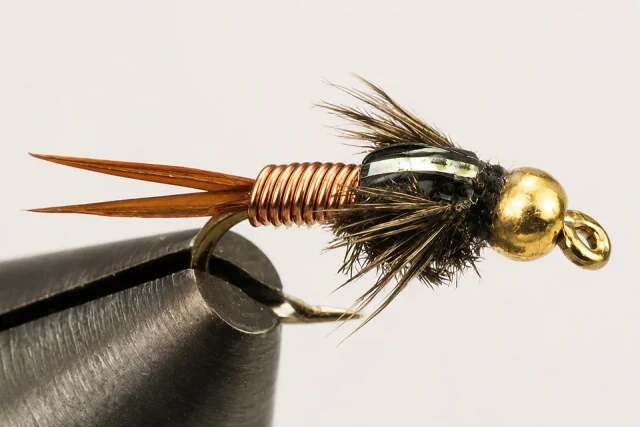
A gold-beaded Zug Bug offered as a clearly named peacock-bodied representative, with peacock sword tail, silver rib and mottled flank wingcase.
Flys and Guides indexes a “Beadhead Peacock Bug” photograph without materials. A peacock body alone cannot establish that fly’s identity. This page therefore uses Matt Grobert’s Orvis Zug Bug dressing and the documented gold-bead variant sold by Jackson Hole Fly Company as one named representative, not a claim that the index photo depicts a Zug Bug.
Work through the numbered steps in order, using the materials list and written proportions as your guide.
01
Seat bead and start thread
Fit the gold bead at the eye of a size 14–16 nymph hook and wind black thread toward the bend, retaining a short tag end of thread.
Bench note The gold bead is the documented beadhead adaptation to the Orvis base recipe.
02
Set peacock sword tail
Tie four or five peacock sword fibers at the bend for a tail about one hook gap long, then bind their bases neatly along the shank.
Bench note A short sword tail maintains the classic Zug Bug silhouette.
03
Tie in tinsel and herl
Anchor narrow silver tinsel at the rear, then secure two peacock herls and wrap them to create a full body while leaving front room for legs.
Bench note The retained thread tag can reinforce the fragile herl before the silver rib goes on.
04
Rib the body
Spiral the retained thread tag through the herl if used, then wind the silver tinsel forward in four or five open turns and secure both.
Bench note Work between the herl fibers rather than flattening the whole body.
05
Wrap hen legs
Prepare a speckled-brown hen feather, secure its tip at the front of the body and wind a sparse collar of rearward-pointing soft legs.
Bench note Leave space immediately behind the gold bead for the flank wingcase tie-down.
06
Add flank wingcase
Tie a mallard or wood-duck flank feather flat across the top at the front, trim it into a short wingcase, then whip finish behind the bead.
Bench note Keep the wingcase centered so the gold bead and peacock body remain visible.
Beyond the bench
On the water.
Drift the beaded fly through riffles and deeper runs as a general aquatic-insect searching nymph. Jackson Hole Fly Company describes its beadhead version for reaching feeding depth in pools and runs.