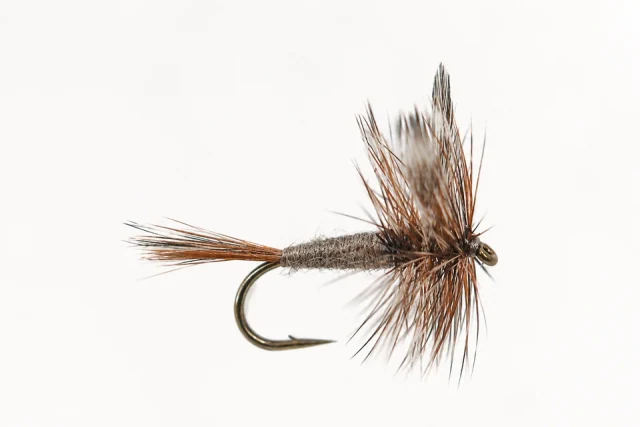
Randall Kaufmann’s olive stillwater dragonfly nymph with marabou tail, fur-blend body, turkey wingcase and prominent eyes.
The source index labels an olive Lake Dragon but gives no dressing. The materials here come from an independent angler’s account of Randall Kaufmann’s Lake Dragon; the sequence assembles those listed components and is not a transcription of Kaufmann’s book or proof that the indexed photo shows this exact tie.
Work through the numbered steps in order, using the materials list and written proportions as your guide.
01
Mount eyes and thread
Start olive thread behind the hook eye and secure the plastic dumbbell eyes across the front shank with firm figure-eight wraps. Cover the remaining shank with an even thread foundation.
Bench note Leave a small clear space at the eye for the finishing knot.
02
Set tail and copper rib
At the bend, tie a short olive marabou tail that moves freely behind the hook. Bind in fine copper wire beside it and leave the wire projecting rearward for later ribbing.
Bench note Keep the tail much shorter than a long streamer tail.
03
Dub and rib the abdomen
Blend equal pinches of olive-green rabbit and Angora. Dub a tapered abdomen from the tail to about halfway up the shank, then spiral the copper wire forward in spaced turns and secure it.
Bench note Leave enough front shank for the broad dragonfly thorax.
04
Anchor the wingcase
Tie the narrow pre-lacquered turkey slip on top at the abdomen front, with its free length extending rearward. Keep it centered so it can later be folded over the thorax.
Bench note The lacquer helps prevent the turkey fibers from splitting.
05
Build thorax and legs
Dub a fuller olive thorax toward the eyes. Secure six pheasant-tail fibers along each side, with their tips angled back no farther than halfway along the abdomen; bind the bases into the thorax.
Bench note Keep both leg groups visible beside the fur body.
06
Close the wingcase
Pull the turkey slip forward across the top of the thorax and secure it immediately behind the plastic eyes. Trim the waste, form a compact head and whip finish with the hook eye clear.
Bench note Use enough tension to flatten the slip without tearing it.
Beyond the bench
On the water.
Work the fly around stillwater shoals and weed margins with short, slow retrieves and pauses. The independent tier specifically discusses reducing weight to fish shallows and weeds; choose weight for the water being fished.