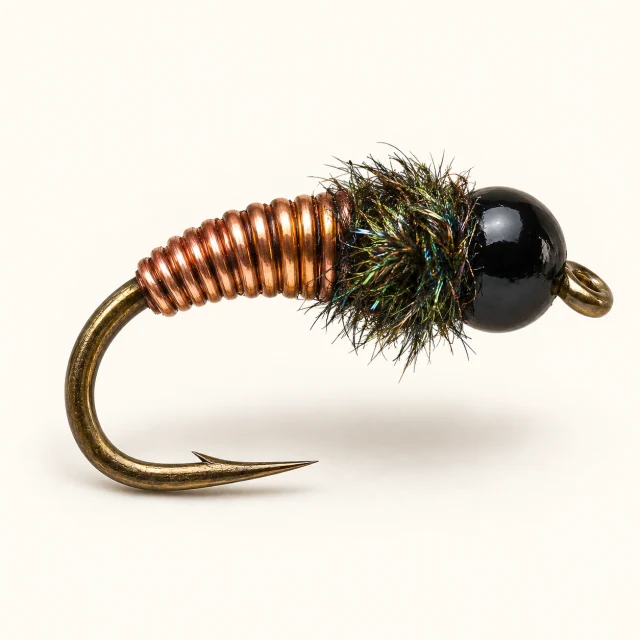
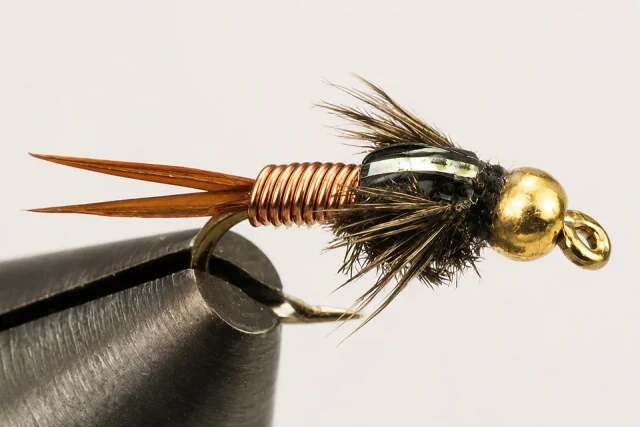
Three contrasting Superhair strands form a slim segmented midge with a pale wingcase and short wing buds.
Charlie Craven’s Jujubee uses three Superhair strands rather than a wire rib. The contrasting strand makes a segmented abdomen, while folded white fibers form both the wingcase and two short side buds.
Work through the numbered steps in order, using the materials list and written proportions as your guide.
01
Set the three strands
Start white thread just behind the eye. Lay two olive and one black Superhair strands along the top of the shank and bind them down to the bend with smooth, close wraps.
Bench note Keep all three strands aligned so the abdomen stays narrow.
02
Wrap the segmented abdomen
Return the white thread to the front of the abdomen. Wind the three Superhair strands together toward it, keeping their contrast visible, then secure and trim the excess.
Bench note Stop before the eye to reserve room for the thorax and wing buds.
03
Change thread and add fibers
Whip finish and cut the white thread. Start black thread at the abdomen front, then tie the white Fluoro Fiber bundle on top with its working length extending rearward.
Bench note Avoid a large tie-in lump on this small hook.
04
Build and cover the thorax
Build a compact rounded thorax with black thread. Draw the white fibers forward over its top and secure them just behind the hook eye without cutting the projecting ends.
Bench note Keep the white cover centered over the black thorax.
05
Form the wing buds
Divide the remaining white fibers into two equal groups. Fold one group back along each side of the thorax and bind both in place behind the eye.
Bench note Check from above that the two side groups are balanced.
06
Finish the head
Cover the fiber butts with a small black thread head, whip finish, and trim the side buds just beyond the wingcase. Leave the hook eye clear.
Bench note Trim only after both buds are secured.
Beyond the bench
On the water.
Use this small, unweighted midge below the surface when trout are taking midge larvae or pupae. Adjust the rig to reach the feeding depth; the fly itself supplies little weight.