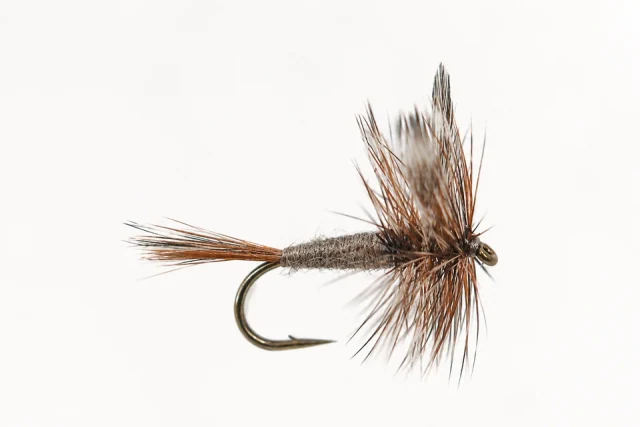
Jack Gartside’s impressionistic fly uses a short pheasant-rump tail, rough fur body, soft collar and aftershaft head.
The source index calls this a Sparrow Streamer. Jack Gartside designed the Sparrow to fish as a nymph, small streamer or even a drowned terrestrial. This olive dressing follows Gartside’s own published materials and tying sequence.
Work through the numbered steps in order, using the materials list and written proportions as your guide.
01
Tie a short rump tail
Start the thread behind the eye and carry it to the bend. Gather the fibers of a short pheasant-rump feather into a square-tipped tail and secure them just forward of the bend.
Bench note The tail should be about one-quarter to one-third of the hook shank, not a long streamer plume.
02
Shape the fur body
Bind the tail butts along the shank as a smooth base. Dub the squirrel-rabbit-Antron blend from the tail forward, making a rough body that grows fuller at the thorax.
Bench note Leave a short clear section at the eye for collar and aftershaft head.
03
Wind the soft collar
Tie a suitable pheasant-rump hackle in front of the dubbed body, concave side down. Wind one sparse turn and stroke the fibers rearward before securing the feather.
Bench note The collar fibers should reach back toward the end of the tail.
04
Attach the aftershaft
Tie a soft pheasant aftershaft feather by its butt immediately in front of the swept collar.
Bench note Handle the fine aftershaft stem gently; it can tear under heavy tension.
05
Wind the head and finish
Make consecutive aftershaft turns toward the hook eye, bind and trim the stem, then form a small thread head and whip finish. Sweep loose fibers away from the eye.
Bench note A sparse aftershaft head lets the separate collar remain visible.
Beyond the bench
On the water.
Fish it subsurface as a nymph or swing or strip it as a small streamer. Vary the size and retrieve to suggest either an insect or small baitfish.