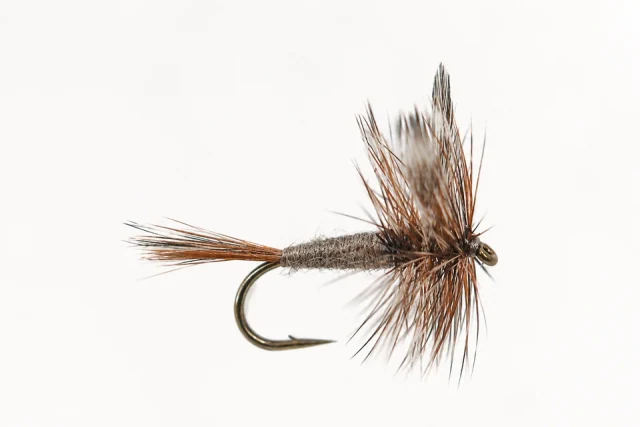
A fine biot abdomen, matching dubbed thorax and CDC gills; the independently published dressing explicitly supports black and olive.
The source index labels separate black and olive Biot Midge photographs but gives no recipe. Granite Bay Flycasters publishes a Biot Midge tying-jam dressing with both colors. This recipe uses its size-20 black version; olive is a documented full-color substitution, without claiming either index photo is the club’s exact tie. The assembly sequence is editorial.
Work through the numbered steps in order, using the materials list and written proportions as your guide.
01
Lay the thread base
Mount the size-20 dry-fly hook and wind black 8/0 thread from behind the eye to the bend in a smooth, thin layer.
Bench note Keep the eye open and avoid adding unnecessary bulk.
02
Tie in a biot
Secure one black goose or turkey biot at the bend with its free length pointing rearward, then return the thread to the front of the abdomen.
Bench note Anchor the biot along the shank to help preserve a smooth taper.
03
Wind the segmented abdomen
Wrap the biot forward in touching turns to about two thirds of the shank, bind it down and trim the excess before forming the thorax.
Bench note The biot edge supplies segmentation without a second rib.
04
Attach the CDC gills
Tie a small white CDC puff at the front third so a short tuft projects up and forward, leaving a narrow gap for the final head.
Bench note Use only enough CDC to suggest midge gills at this scale.
05
Dub thorax and finish
Dub a compact black Superfine thorax behind the CDC tuft, secure a small thread head and whip finish without trapping the CDC tips.
Bench note The thorax should stay small beside the slim abdomen.
Beyond the bench
On the water.
Present near the surface film during a small-midge emergence, where the CDC gills can remain visible while the slim biot abdomen rides low. Match size and shade to the insects actually present.