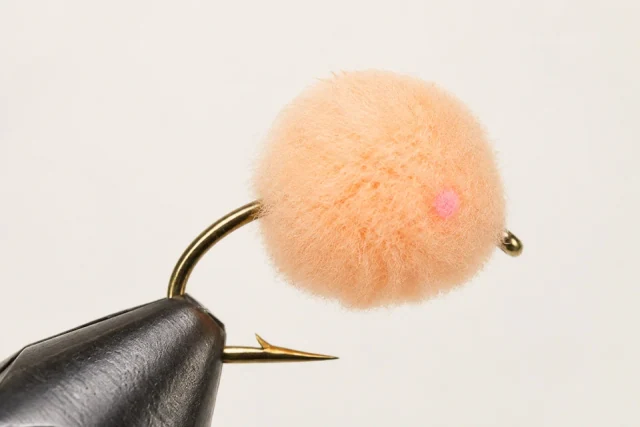
David Knowles’s compact, two-tone beaded yarn fly, tied here in an orange-and-McCheese modern egg-style dressing.
David Knowles developed the Y2K around two contrasting lengths of yarn and a front bead. This page follows Trident Fly Fishing’s published orange-and-McCheese McFlyFoam tutorial. It is a modern dressing of the distinct Y2K fly, rather than a plain round Glo Bug or the glass-bead-centered Unreal Egg.
Work through the numbered steps in order, using the materials list and written proportions as your guide.
01
Seat the gold bead
Slide the tungsten bead to the hook eye, mount the hook and build a short white-thread dam immediately behind the bead.
Bench note Keep the bead firm while leaving room for a clean hook eye.
02
Match the two yarn strips
Separate equal-sized, sparse lengths of orange and McCheese McFlyFoam. Lay them together along the top of the shank and bind both securely with close thread turns.
Bench note Unequal bundles produce an uneven two-tone shape; use less yarn than a full round egg would need.
03
Lock the thread wraps
Bring the thread back to the bead, whip finish behind it and touch the thread wraps with a small amount of superglue.
Bench note Let the adhesive cure before shaping the soft yarn.
04
Trim the short body
Gather the two yarn colors and clip their loose ends evenly into a compact, softly rounded profile without covering the hook gap.
Bench note Trim a little at a time; the finished Y2K should remain sparse enough to sink.
Beyond the bench
On the water.
Drift the compact, weighted yarn fly below the surface for trout. The bead helps it sink, but adjust rig depth and drift to the current. Keep clear of active spawning fish and redds.