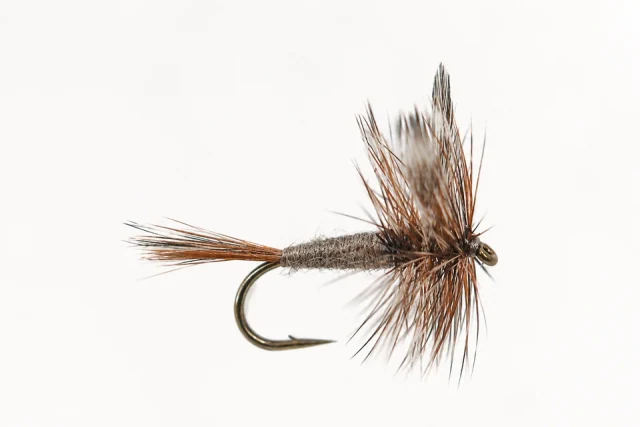
A brown, copper-beaded biot midge pupa with blue wire segmentation and a small UV-brown thorax; one sourced representative of the indexed label.
The Flys and Guides index names a brown beadhead biot pupa but does not publish its materials. This recipe follows Cheech’s independently published 2016 Biot Midge Pupa material list; it is a representative tie, not a verified reconstruction of the older indexed photo. The step wording here is editorial.
Work through the numbered steps in order, using the materials list and written proportions as your guide.
01
Seat the bead
Slide the 2.0 mm copper bead to the hook eye, clamp the scud hook and start camel thread immediately behind the bead.
Bench note Keep the bead’s larger opening toward the hook bend if needed to seat it against the eye.
02
Anchor wire and biot
Run thread to the rear of the curved shank. Tie the small blue wire and one brown stripped goose biot securely along the shank.
Bench note Make a level thread underbody so the biot wraps do not develop a lump.
03
Wrap the biot abdomen
Wind the brown goose biot forward in close turns over most of the shank and secure it before the bead, leaving a short space for the thorax.
Bench note Use hackle pliers if the short biot end is difficult to hold.
04
Counter-rib in blue
Spiral the blue wire forward in several evenly spaced turns over the biot body, bind it down and break or trim the excess.
Bench note Do not bury the entire brown body under wire.
05
Dub and finish
Dub a compact UV-brown Ice Dub thorax immediately behind the copper bead, whip finish behind the bead and clear the hook eye.
Bench note A small thorax preserves the midge-pupa silhouette.
Beyond the bench
On the water.
Fish beneath a buoyant dry fly or indicator in water holding midge pupae. The source describes using this pupa under a foam dry; adjust the depth and drift to the water rather than treating one rig as universal.